Executive summary
A recovery layer for travel value that usually disappears into operational noise.
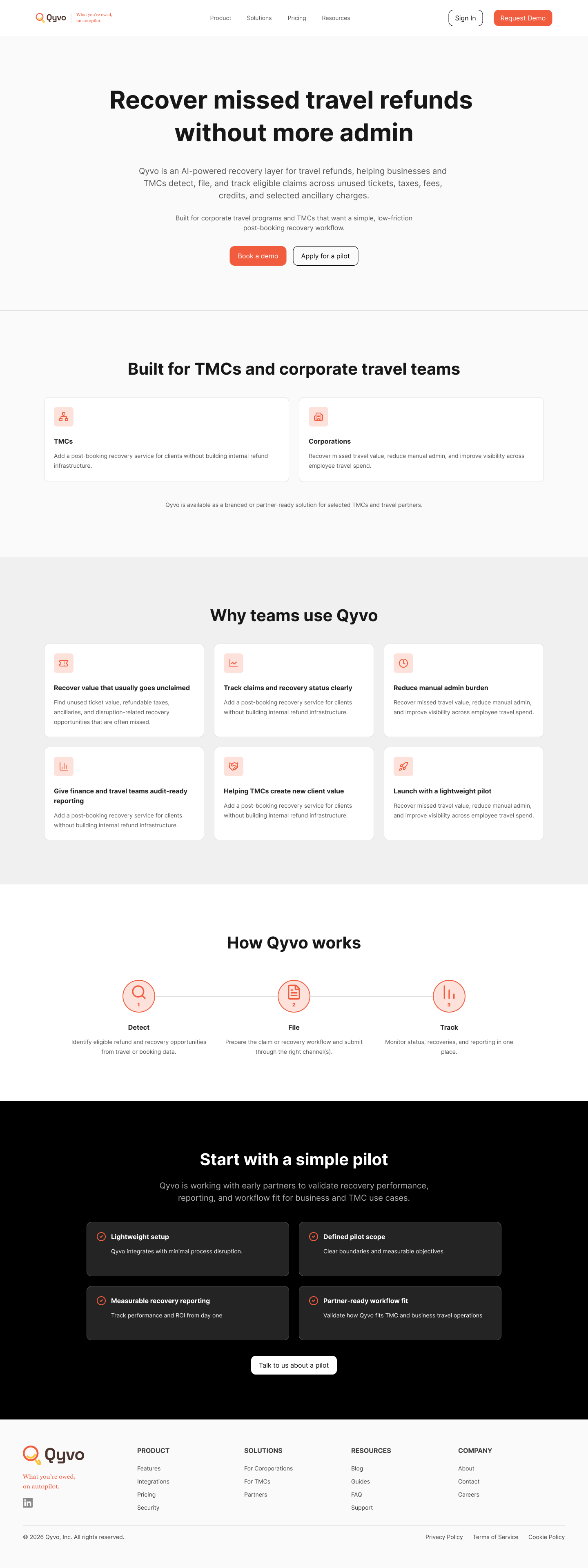
QYVO detects refund opportunities after a trip is booked, prepares the claim and gives travellers or travel teams one place to file, track and report recovery.
The project began as a consumer service. Research exposed a trust barrier around granting inbox and booking access, while the same underlying problem was larger and more operational for travel management companies.
Over 12 months I led a UX Researcher, UX Designer and UI Designer through the B2C-to-B2B/TMC pivot. I set direction, worked hands-on across research, UX and UI, and owned workflow, deadlines and budget.
01 · Problem and niche
The booking ends. The financial leakage continues.
Schedule changes, disruptions, unused tickets and fare-rule changes can create recoverable value after purchase. The evidence is spread across airline policies, GDS records, inboxes, expense systems and spreadsheets.
For an individual, the process is confusing and easy to abandon. For a travel team, it becomes repeated manual work across many bookings—with fragmented status, ownership and reporting.
02 · Product model
One recovery loop, designed for both trust and scale.
Connect
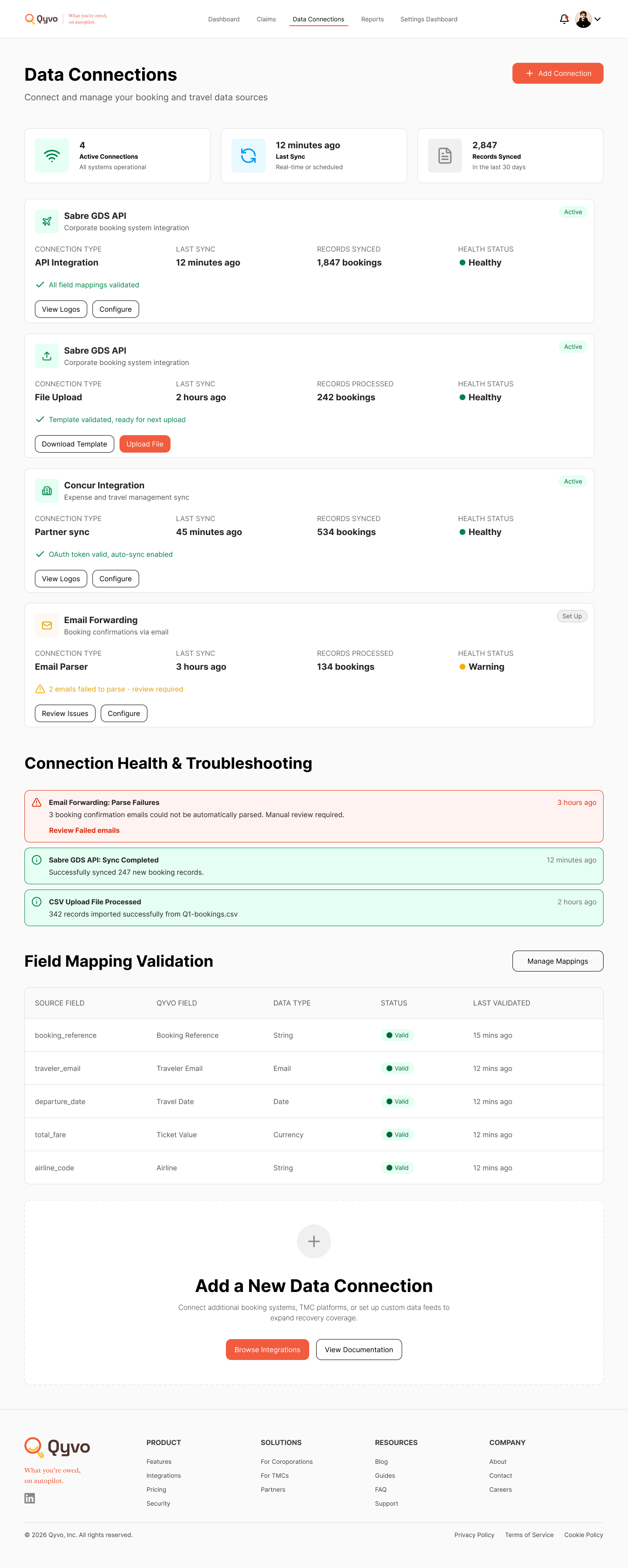
Bring booking data in through GDS, expense platforms, forwarded email or manual file upload.
Detect
Surface potential value with a reason, amount and the source data behind the opportunity.
Prepare
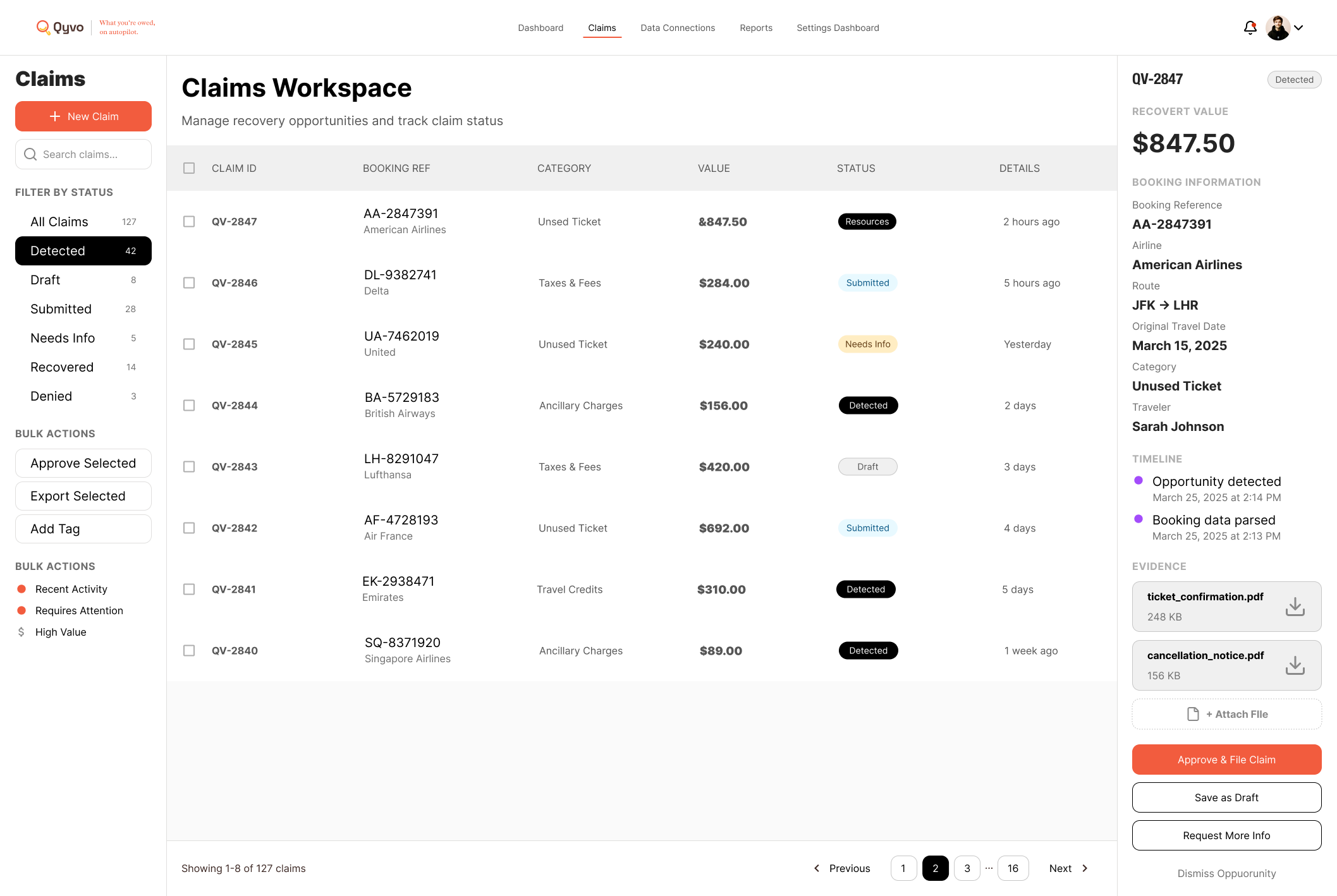
Move each claim through explicit states: detected, draft, submitted, needs info, recovered or denied.
Recover
Confirm the refund or credit lands and record the outcome against the original claim.
Report
Turn individual cases into an operational view of recovery, status and performance over time.
03 · My role
Leading coherence across two markets and one product system.
As Design Lead, I set direction and stayed hands-on across research, UX and UI. I owned architecture, design system, workflow, schedule and budget while each specialist led their discipline.
- Discover
Research direction
I shaped the questions and joined synthesis; the UX Researcher conducted the studies, process analysis and benchmarking.
- Frame
UX architecture
I defined the journey and workflow; the UX Designer developed parts of the flows under my direction.
- Pivot
B2C to B2B/TMC
I led the strategic shift toward batch workflows, organisational ownership, integrations and reporting.
- Systemise
UI direction and system
I set the UI direction and co-created the interface; the UI Designer developed part of the execution under my direction.
- Ship
Design operations
I organised scope, workflow, reviews, deadlines and budget, then led design QA through B2C and B2B delivery.
04 · Product process
The pivot changed the operating model, not the core problem.
The UX Researcher led the studies; I framed the inquiry, participated in the work and translated findings into product decisions. Trust remained a barrier, so the B2C flow added manual upload and forwarded email.
Under my direction, the team moved QYVO closer to travel operations: from one traveller pursuing one refund to a workspace handling many claims, sources, organisations and reporting periods.
How can one traveller recognise and pursue an eligible refund?
Offer clear consent and more than one way to provide booking data.
How can a team recover value repeatedly, visibly and at scale?
05 · Product experience
Designed around the work—not around a feature catalogue.
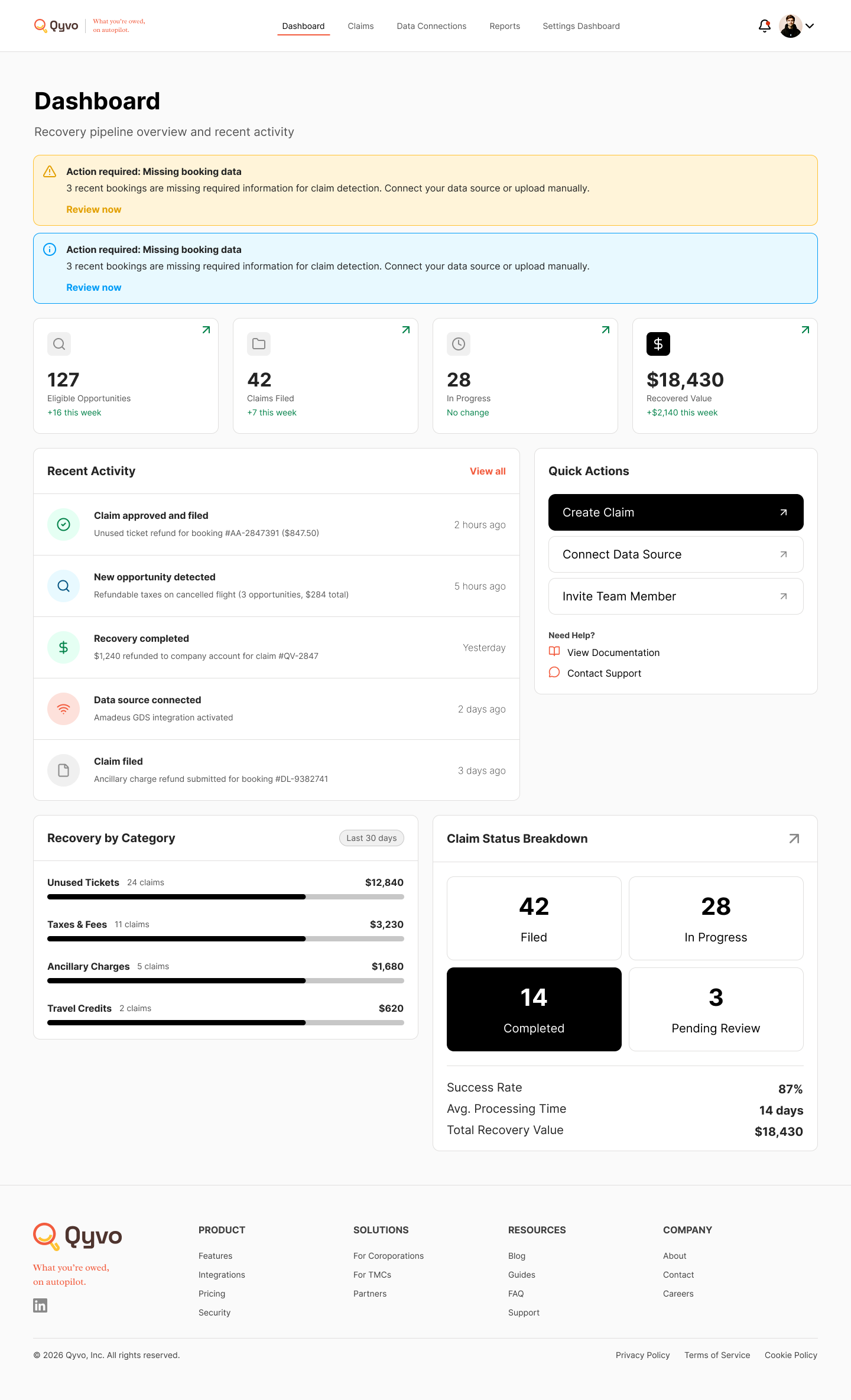
Recovery dashboard
Prioritise opportunities, see active value and understand what needs attention now.
Claims workspace
Filter and manage cases with consistent status, traveller, booking and value context.
Data connections
Connect GDS, expense and inbox sources, or start safely with a file upload.
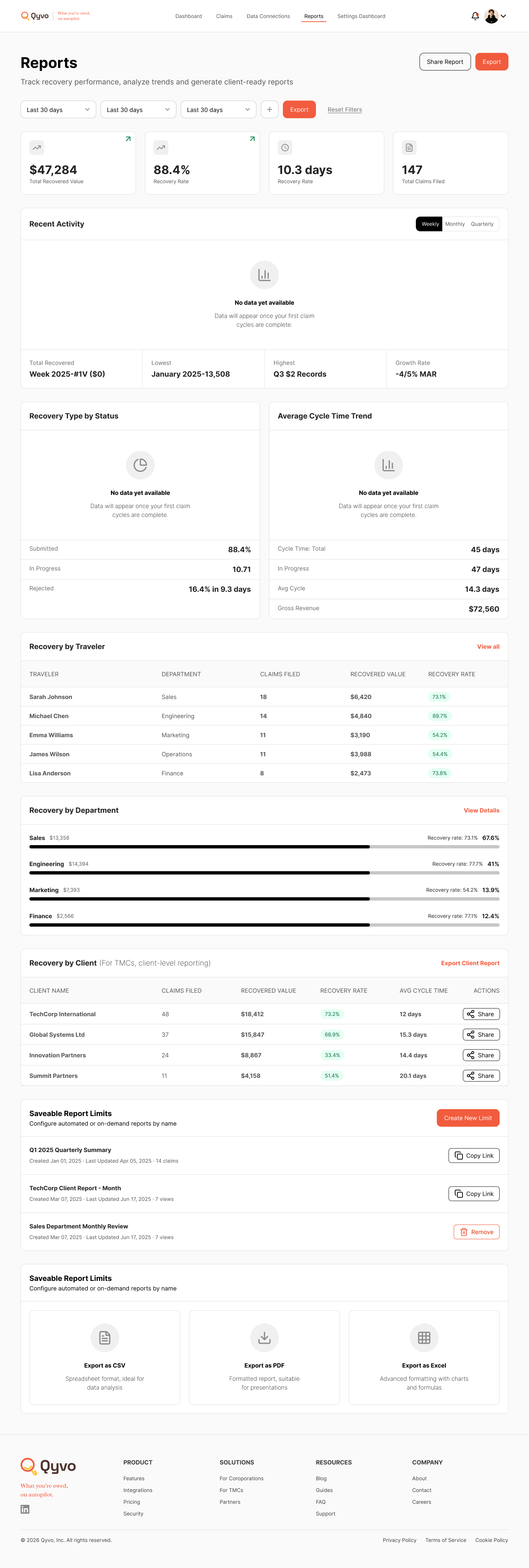
Reports
Show recovery totals, status distribution and performance without reconstructing the story manually.
06 · Evidence and outcomes
A complete product system—not a pitch-deck prototype.
- Research evidence
38+ hours documented
The UX Researcher led the studies; I joined the inquiry, synthesis and resulting product decisions.
- Shipped scope
B2C and B2B delivered
Both consumer and travel-management experiences represented in the design source were implemented during the 12-month project.
- Early traction
3,000 verified sign-ups
The launch generated 3,000 verified waitlist emails in its first 10 days, establishing clear demand for automated recovery.
The strongest outcome was not a single screen. It was a product model that survived a market pivot—from a trusted consumer assistant to an operational recovery platform.
07 · What this demonstrates
Design leadership through uncertainty.
Product judgment
Use research to change the operating model when the original route creates a structural trust or adoption barrier.
Design leadership
Give researchers and designers clear ownership while setting direction and contributing hands-on across disciplines.
Delivery depth
Connect workflow, schedule and budget management with production-ready UX, UI systems and implementation QA.